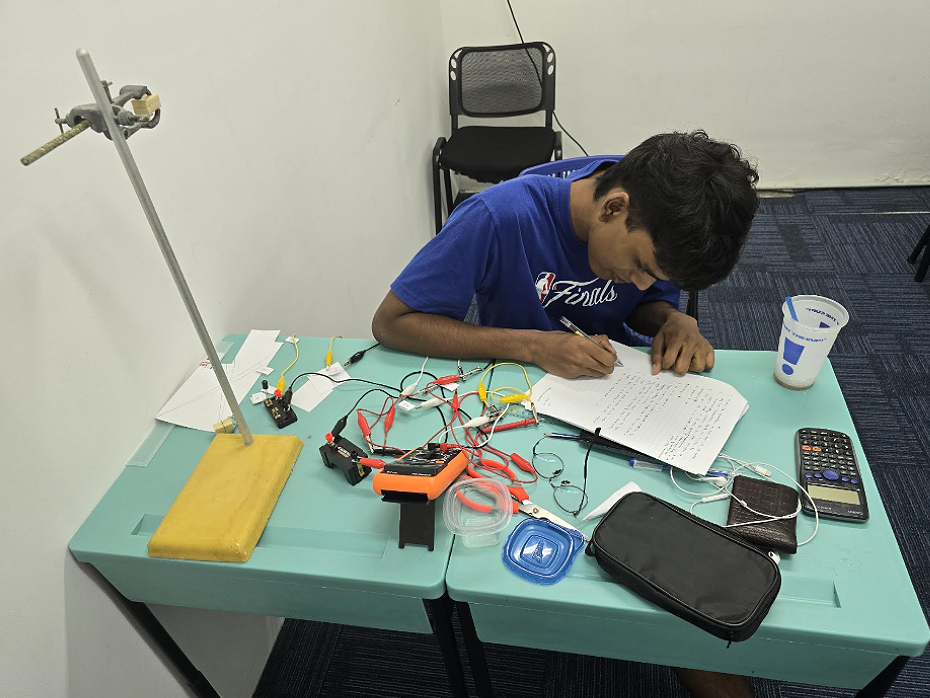
Ask a Secondary 4 student how they are revising for Physics and you will hear about topical worksheets, past papers and Paper 2 structured questions. Ask about the practical and the answer is usually a shrug, or a hope that school lab sessions have covered it.
That gap is expensive. Paper 3 carries a fifth of the O-Level Physics grade, and it rewards a set of skills the written papers barely touch. Students who walk in expecting to be tested on content find themselves tested on how carefully they measure, how clearly they record, and whether they can be honest about their own results. Working through that shift is a large part of what we do in O level physics tuition at Candela during the run-up to the papers.
A fifth of the grade, assessed on different things
According to the Singapore-Cambridge O-Level Physics syllabus, Paper 3 runs for 1 hour 50 minutes and carries 40 marks, or 20 per cent of the subject grade. It splits into two sections of 20 marks each, with roughly 55 minutes for each: one or two compulsory practical experiment questions in Section A, and a single compulsory question in Section B.
The more useful detail sits in how those marks are described. Practical assessment covers planning, manipulation of apparatus, measurement and observation, presentation of data and observations, and analysis, conclusions and evaluation. Planning accounts for around 15 per cent of the practical assessment, with the remaining 85 per cent spread across the others.
Read that against the theory papers, where knowledge with understanding takes roughly 45 per cent of the marks and handling information and solving problems roughly 55 per cent, and the difference in emphasis becomes obvious. Paper 3 is not a shorter Paper 2 done at a bench.
Recording data is where marks quietly go
Most students lose practical marks in the recording, not the experiment. The reading is taken correctly, the apparatus is set up sensibly, and then the results table costs them. A table an examiner can credit tends to look after a few unglamorous things:
- Every column headed with a quantity and its unit, written in the accepted form.
- Raw readings recorded to the precision the instrument allows, with trailing zeros kept where they belong.
- All values in a column given to a consistent number of decimal places and significant figures. There is a structured significant figure and decimal place rules that all students have to follow.
- Derived quantities worked to a sensible number of significant figures, not copied straight off a calculator display.
- The table drawn before the readings are taken, so nothing has to be crammed in later.
Graph work sits in the same category. Scale choice, axis labels with units, plotted points marked clearly and a best-fit line drawn with a ruler are all straightforward to get right, and all easy to lose under time pressure.
That pressure is usually self-inflicted. Students who take extra repeats in the hope of a cleaner average often reach the analysis questions with barely enough time to answer them, and those questions carry more marks than the extra readings ever will. Taking the readings the method asks for and stopping there leaves room for the part of the paper that pays.
The planning question can be tackled systematically
Planning questions ask you to design a procedure, and they reward answers that read like instructions someone else could follow. Vague intentions score badly. A plan that names the apparatus, states which quantity is varied and which is measured, says what is kept constant, and explains how the results will be used earns marks in a way that “I would measure the length and time it” does not.
The reason so many students freeze on these questions is that they treat each one as a fresh problem. It helps to have a checklist to run through instead. We teach VPARS (Variables, Procedures, Analysis, Reliability, and Safety) as a way of interrogating any planning question in a fixed order. Identify the independent, dependent, and controlled variables. Set out the procedure as numbered steps. Say how the data will be analysed, including what will be plotted against what. Address reliability through repeats and averages. Note any safety precaution the set-up calls for. Not every question draws on all five, and a question worth four marks will not need the same depth as one worth eight, but running through the list stops you from omitting the part you would otherwise have skipped.
Reliability is the step most often left out. Saying that you would repeat the measurement and take an average is simple to write and frequently forgotten when the clock is running. So is stating a sensible range and number of readings for the variable you are changing.
Diagrams help more than students expect. A clear labelled sketch of the set-up can carry several parts of a plan at once, and it costs less time than a paragraph trying to describe the same arrangement in words.
Analysis and evaluation reward honesty
The evaluation parts of Paper 3 ask what went wrong and what you would change, and there is no advantage in pretending the experiment ran perfectly. Identifying a real source of error in your own procedure, then proposing an improvement that actually addresses it, is the answer being marked. Generic lines about human error or parallax, added without reference to what you did, tend to earn nothing.
The same applies to conclusions. A conclusion should follow from the numbers in front of you, including when those numbers are untidy. Students who have practised drawing conclusions from their own imperfect data handle this far better than students whose only experience is model answers built on clean results, which is one more reason past-year papers alone won’t save a Physics grade.
What to practise before the exam
Practical skill improves with repetition of the small mechanics, and a good deal of it can be drilled on paper without a laboratory:
- Draw blank results tables for common experiments until headings and units come automatically.
- Plot a few graphs by hand, paying attention to scale choice, axis labels and best-fit lines.
- Write out full plans for standard investigations, then check whether a classmate could follow them without asking a question.
- Take a set of your own messy readings and write the conclusion and evaluation they honestly support.
Walking in prepared
The practical rewards preparation of a particular kind: familiarity with the instruments, a fixed routine for recording, and enough experience of untidy data to stay steady when a reading refuses to behave. None of that develops in the week before the exam, though a fortnight of deliberate practice on tables, graphs and plans does show up in the script.
Candela Learners Cove is a tuition centre, and our Upper Secondary Physics classes are built to reinforce what students meet in school, including the practical skills that lab time alone does not always have room to drill. If your child is heading into Paper 3 unsure what the marks are for, we would be glad to work through it with them.