
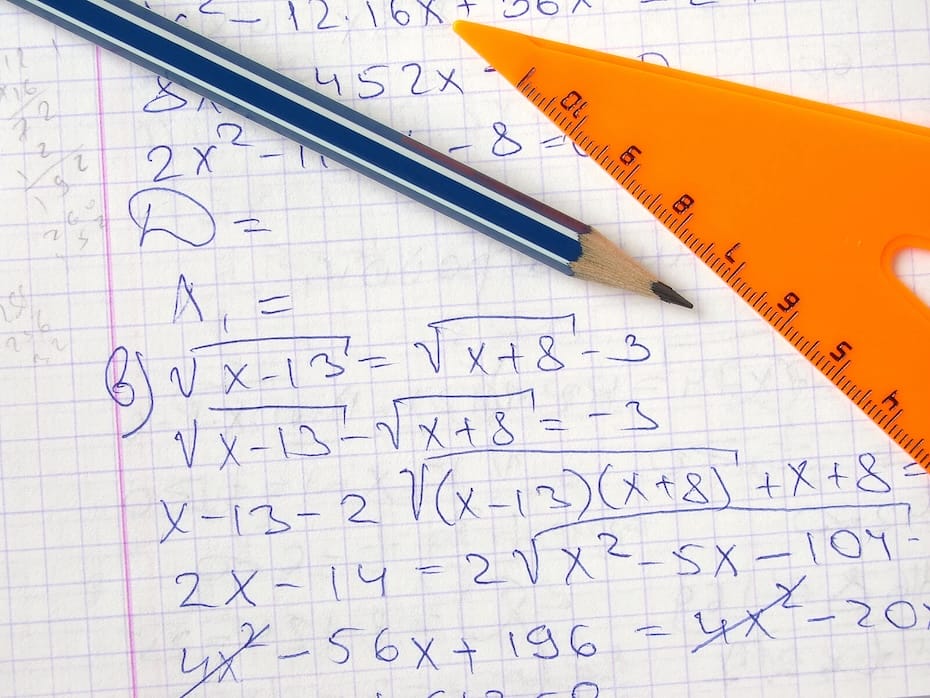
Starting secondary school maths can feel like stepping into a whole new world. The numbers are still there, but suddenly there are letters mixed in, and the questions look nothing like what you were doing just months ago. For many students, algebra is the first real hurdle, and how they handle it in lower secondary sets the tone for everything that follows.
The truth is, algebra is not as frightening as it looks. Most students who struggle with it do so not because they lack ability, but because a few foundational ideas were never made clear. Get those right early, and the rest starts to click into place.
If your child is transitioning from primary to secondary school math, the shift in thinking required for algebra is one of the most important adjustments to make. And it is absolutely manageable with the right support.
This is also where math tuition for secondary students can make a genuine difference, especially in those early months when the concepts are new and confidence is still being built. A good tutor does not just reteach what was done in class; they help students understand the why behind each step, which is what makes algebra stick.
So, what exactly do lower secondary students need to get right? Here are the core ideas that matter most.
Understanding What a Variable Actually Means
Before anything else, students need to understand what a letter in a maths equation represents. A variable is simply a placeholder for a number we do not know yet, or a number that can change depending on the situation.
Many students treat letters like labels, the way “kg” means kilograms. That misunderstanding causes real confusion later. When a student sees 3x, they need to understand it means “3 multiplied by some number called x“, not “3 kilograms” or “3 of something”.
Once this clicks, a lot of algebra starts to make more sense.
Simplifying Expressions: Like Terms Only
One of the earliest algebra skills taught is simplifying expressions, and it trips students up constantly. The rule is straightforward: you can only combine like terms.
- 3x + 5x = 8x (both are x terms, so they can be added)
- 3x + 5y cannot be simplified further (different variables)
- x² + x cannot be combined (different powers)
Think of it like fruit. You can add 3 apples and 5 apples to get 8 apples. But you cannot add 3 apples and 5 oranges and call them 8 apples. The type has to match.
Students who internalise this rule early avoid a huge number of careless mistakes throughout secondary school.
The Order of Operations Still Applies
BODMAS (Brackets, Order, Division, Multiplication, Addition, Subtraction) does not disappear just because letters have entered the picture. It becomes even more important.
When evaluating or simplifying algebraic expressions, the order of operations must be followed exactly. A common mistake is adding before multiplying simply because the addition appears first when reading left to right. That habit needs to be corrected early.
Practising with mixed numerical and algebraic expressions side by side helps students see that the rules are consistent, whether numbers or letters are involved.
Solving Linear Equations: The Balance Method
Solving equations is the heart of algebra, and the concept students need to grasp is balance. An equation is like a set of scales: whatever you do to one side, you must do to the other.
To solve 2x + 3 = 11:
- Subtract 3 from both sides: 2x = 8
- Divide both sides by 2: x = 4
This sounds simple, but students often rush and skip steps, especially when they start doing it mentally. Encouraging them to write out every step, even when it feels unnecessary, builds both accuracy and good habits that carry through to more complex equations later.
Substitution: Putting Numbers Back In
Substitution is where algebra starts to feel useful. Students are given the value of a variable and asked to find the value of an expression. For example, if x = 3, what is 4x – 1?
The answer: 4(3) – 1 = 12 – 1 = 11.
Where students go wrong is forgetting to apply the order of operations, or mishandling negative values. If x = -2 and the expression is x², the answer is 4, not -4. That distinction matters enormously in higher-level topics.
Spending time on substitution early, with both positive and negative values, pays off significantly.
Why Getting It Right Early Matters So Much
Algebra in lower secondary is not just a standalone topic. It feeds directly into:
- Linear graphs and gradient calculations
- Simultaneous equations
- Quadratic expressions and factorisation
- Geometry and trigonometry problems that require algebraic working
Gaps in the basics do not stay small. They compound. A student who does not fully understand like terms in Secondary 1 will find factorisation in Secondary 3 genuinely baffling, because they are building on a shaky base.
The good news is that the fundamentals are fixable. With consistent practice and clear explanation, most students can get comfortable with algebra relatively quickly. The key is catching the misunderstandings before they become habits.
A Strong Start Makes All the Difference
Lower secondary is not too early to take maths seriously, and it is certainly not too late to course-correct if your child is already finding it difficult. Algebra is learnable. The concepts, while new, are logical. And students who get a solid grounding now will find the jump to upper secondary maths far less daunting.
If your child needs extra support building those foundations, Candela Learners Cove offers dedicated secondary school and JC tuition designed to help students genuinely understand the subject. Visit us today and take the first step towards building a stronger maths foundation.


Linkedin Profile 